 Es Posible
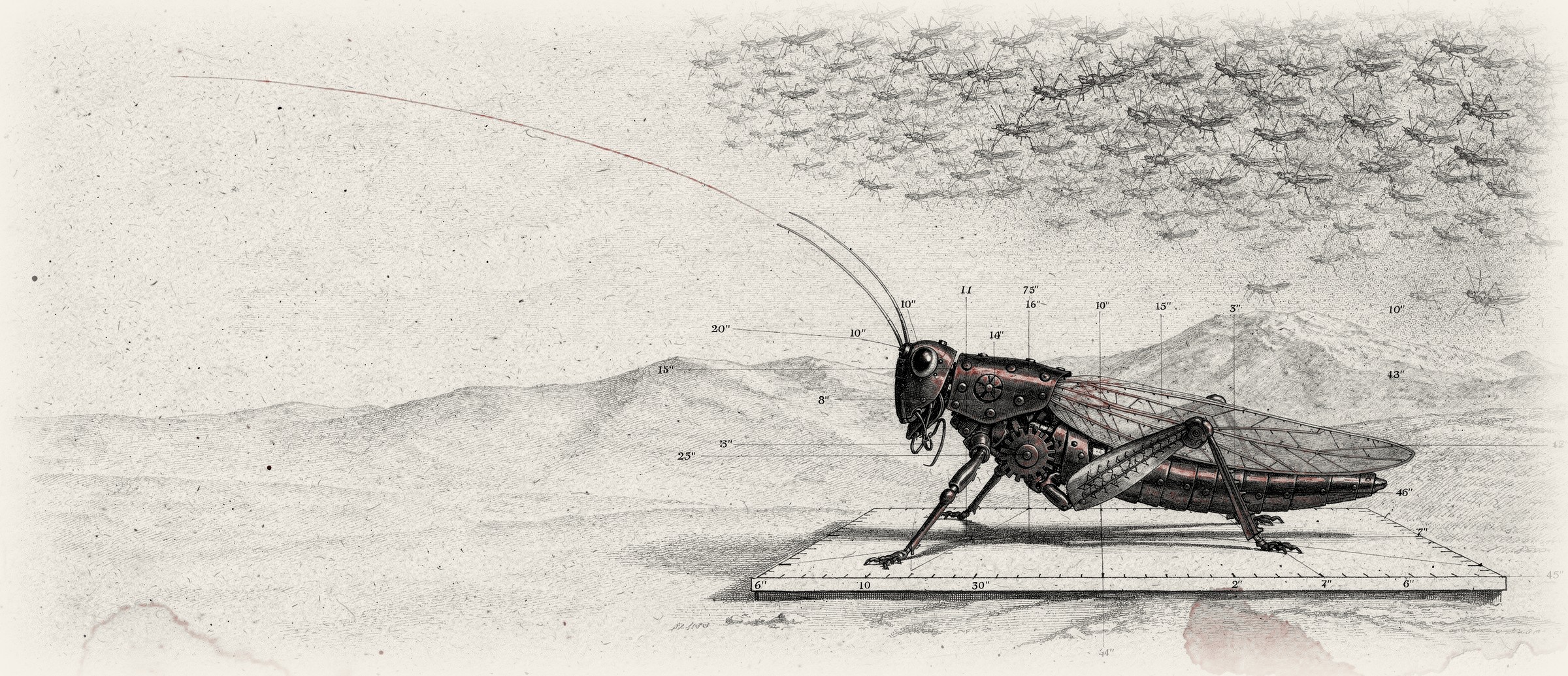
CJNG is one engineer away from the sky
Nobody is explaining to Mexicans what is coming.
The bosses will fall. Whole structures will fall. And nobody has said what happens to your life the day that occurs.
Today a hidden man kills a police officer with a drone. Tomorrow he types an order and a hundred machines shut down a city.
Between those two sentences there is a date. This work calculated it first.
This work belongs to three people. For Ghaleb Krame and Amanda Davies, with whom we built the model, defended the numbers and put the date on it.
This says when the Jalisco New Generation Cartel will make the jump to drone swarms, what it will attack first, in which states, and what happens to you even if you live in none of them. The forecast is not a hunch: it comes from an award-winning academic model that compared four armed groups that already made that jump.
The award is not handed out by a government or a media outlet. It is handed out by an international academic jury reviewing blind, at the 23rd European, Mediterranean and Middle Eastern Conference on Information Systems, held in Cyprus in February 2026.
Which means that before this forecast reached a microsite, it had already passed peer review and won its category against the rest of the conference.

No government pays for this work. No party. No advertiser. The reader pays for it. Share it, and if it raises money, forty percent is yours.
The first person to address this systematically is named Ghaleb Krame. In June 2023 he published, with Vlado Vivoda and Amanda Davies, the article Narco drones: tracing the evolution of cartel aerial tactics in Mexico's low-intensity conflicts, in Small Wars & Insurgencies, one of the reference journals on armed conflict. It appeared online on June 18, 2023 and reconstructed the evolution of Mexican cartel drone tactics between 2017 and 2022: rising technological sophistication, payload capacity and operational adaptation within low-intensity conflicts.
That work set the starting point. Drones stopped being an isolated tool and became an aerial capability in evolution. Almost two years before the United States designated CJNG a foreign terrorist organization in February 2025, that trajectory was already reconstructed and published: from the armed drone intercepted in Valtierrilla, Guanajuato, on October 20, 2017, a 3DR Solo carrying an improvised explosive device known as Papa Bomba, through the evolution of payloads, technological adaptation and the tactical employment of unmanned aircraft. The article itself identifies that episode as the first documented and publicly acknowledged case of a drone armed with an IED in the hands of a Mexican cartel.
And here is the precision this work owes itself: it was not the first tactical analysis of the phenomenon. Robert J. Bunker and John P. Sullivan had been documenting cases of drone use by Mexican criminal organizations since 2017. The difference was scope. Krame, Vivoda and Davies turned scattered episodes into a trajectory of technological and tactical evolution, and framed it explicitly within low-intensity conflict dynamics. In Mexico, meanwhile, the phenomenon was still being treated as a crime-page curiosity.
Three years later the question changed. It stopped being what cartels had done with drones and became what the next operational leap of that capability would be. That is what we went to Cyprus to measure.
In February 2026, Krame, Amanda Davies and the author of these lines took that work a step further and presented in Cyprus what nobody had done: putting a calendar on the day the Jalisco New Generation Cartel stops being a group that uses drones and becomes a group that operates with swarms. The jury awarded it best research of the conference. The window we produced was twelve to eighteen months.
Ese mismo mes mataron a El Mencho y el cártel respondió en veinte estados. Cinco meses después, el Tesoro de Estados Unidos ejecutó la mayor acción de su historia contra ese cártel y nombró líder a un ciudadano estadounidense. We did not react to that news. It was already written, with an international jury and an earlier publication date.
And it did not stay in an academic conference. We took that work to the State Department.
On June 2, 2026, four months after Cyprus, Secretary of State Marco Rubio testified before the Senate Foreign Relations Committee and warned about Mexican cartels use of drones, noting it had become a growing concern for Washington and that those machines could be turned on American targets.
Three months after that testimony, the United States Army began shooting cartel drones out of the sky at the border, and its own figures revealed more than three hundred for the year.
That is the full chain, and every link has a public date. Krame saw it in 2023. We put a date on it in February 2026. Rubio said it under testimony in June. The border lived it in August.
What follows explains how you put a date on something like this, and why the clock does not stop with soldiers.
What you have read so far is context. What follows is the work: what they will hit, in which states, in what order, on what timeline, and what it will cost you.